MARKET TRENDS
Data Centers and PFAS Drive New Water Era
Population growth, PFAS pressure and data centre expansion are driving Australian utilities to invest in rainfall-independent water supply
26 Apr 2026
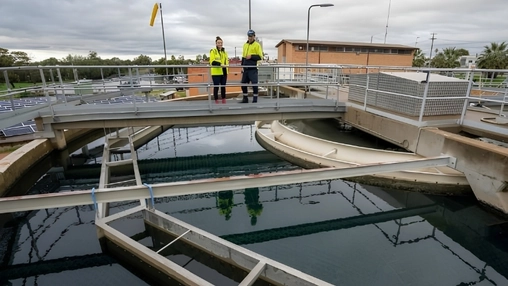
Australia is no longer willing to wait for rain. Across the country, water utilities are rethinking how they source, treat, and deliver water, moving away from rainfall dependence and toward systems engineered to perform regardless of what falls from the sky.
Sydney Water is leading the charge. Its AUD 1.3 billion Upper South Creek Advanced Water Recycling Centre, due for commissioning in 2026, will treat up to 70 megalitres of wastewater daily through reverse osmosis and biological treatment. The facility serves Western Sydney's fast-expanding Aerotropolis and the new international airport, and it's built to scale, designed for a region projected to grow from 26,000 to 650,000 residents by 2056. The utility has also committed AUD 34 billion over the next decade to renew assets and expand recycled water and stormwater infrastructure across Greater Sydney, with a purified recycled water demonstration plant already running at Quakers Hill.
The shift extends well beyond New South Wales. Water Corporation in Western Australia has set a target to recycle 35% of all wastewater generated by 2035, funding decentralised plants across Perth's growth corridors. South Australia's Bolivar facility is expanding to lift reuse volumes for agriculture and industry.
Contamination is forcing the issue further. Following endorsement of Australia's PFAS National Environmental Management Plan 3.0 in March 2025, utilities face new pressure to move from containment to active remediation. Capital is flowing toward granular activated carbon, ion exchange, and advanced membrane systems. PFAS detections at multiple Sydney filtration plants throughout 2025 have sharpened community expectations and accelerated procurement decisions considerably.
Then there's an entirely new category of demand. Sydney Water projects that proposed data centre developments will require an additional 90 billion litres of treated water annually by 2035. That's equivalent to roughly 15 to 20 percent of current total supply. Rather than divert from potable sources, utilities are developing dedicated recycled water streams for non-potable industrial customers.
Australia's water treatment market, valued at approximately USD 1.6 billion, isn't simply growing. It's reorganising, with treatment diversity and contaminant resilience no longer optional, but baseline expectations.
Related News


topics on the agenda
THE VALUE OF EFFECTIVE DECENTRALISED WATER RECYCLING
Day 1: MONDAY, 7 DECEMBER, 2026
12:00 - 12:25
DIGITAL TRANSFORMATION AND AI IN WATER TREATMENT OPERATIONS
Day 1: MONDAY, 7 DECEMBER, 2026
14:00 - 14:25
ADVANCES IN PFAS CAPTURE AND DISPOSAL IN LANDFILL AND SEWAGE TREATMENT FACILITIES
Day 1: MONDAY, 7 DECEMBER, 2026
14:30 - 14:55
SUBSCRIBE FOR UPDATES
By submitting, you agree to receive email communications from the event organizers, including upcoming promotions and discounted tickets, news, and access to related events.